
 Sweden
  Español
  Italiano
  Deutsch
  Français
 Discopathy - herniated disc and Atlas
ATTIVA L’AUDIO DEL PLAYER
A herniated disc is the loss of part of the nucleus pulposus of the intervertebral disc. The intervertebral disc is the cushion between two vertebrae. The leaked pulpy part can compress the nerve endings, creating a mechanical conflict that results in pain or numbness in the limbs.
The intervertebral discs not only make the spinal column flexible, but also act as a shock absorber. They can withstand extremely high loads provided that the force is distributed over the entire surface of the disc and that the disc has not degenerated. It is estimated that if you hold a 10 kg object in your hand with your arms outstretched, the load on the intervertebral discs reaches 800 kg.
Thanks to the practice of systematically photographing each person in front of a specially measured wall, we at Atlantomed can state with certainty, that the development of a herniated lumbar or cervical disc is always associated with significant pre-existing postural damage, with a visible misalignment of the pelvis or a chronic lateral deviation of the spine (scoliosis) or cervical respectively.
In medicine we talk about 'worn' intervertebral discs. Have you ever wondered how discs wear out and why this should happen? Perhaps doctors confuse intervertebral discs with car shock absorbers, which wear out after so many kilometres? If this were true, would it mean that you should move as little as possible to keep your discs healthy? How is it then that people who practise sport and put a lot of strain on their intervertebral discs remain healthy?
The truth is that the intervertebral discs do not wear out, but rather undergo a process of degeneration that reduces their volume more and more, until the outer fibrous ring breaks. Why does this happen? When discs are constantly loaded unilaterally and subjected to uninterrupted compression by extreme muscle tension, they eventually fail like a bad dam! You know that sandwich with mayonnaise in it? If you squeeze it too hard, the mayonnaise comes out the sides!
The discs can and must be loaded to stay healthy, but the load must alternate with a release, the pressure must not be constant! We can say that the intervertebral discs correspond to the keys on a piano: If you press the keys in a certain sequence, you produce music, but if you keep pressing the keys constantly, no sound is produced.
In medicine, the principle of cause and effect is often reversed, so that the herniated disc is transformed from victim to perpetrator. The poor intervertebral disc, which is constantly being squeezed as if it were in a vice that is also pressing crookedly, goes from being the victim of the unfavourable circumstances in which it finds itself to being the cause of all evil. This is according to medical theories. However, it cannot be explained why, after having operated on the hernia, in many cases the pain persists or even increases, due to the further damage and scars of the surgery, while the problem returns to the patient shortly afterwards. The percentage of failed operations is so high that lately even surgeons are beginning to question whether the chisel is the right solution in 95% of cases.
How does a discopathy or herniated disc develop?
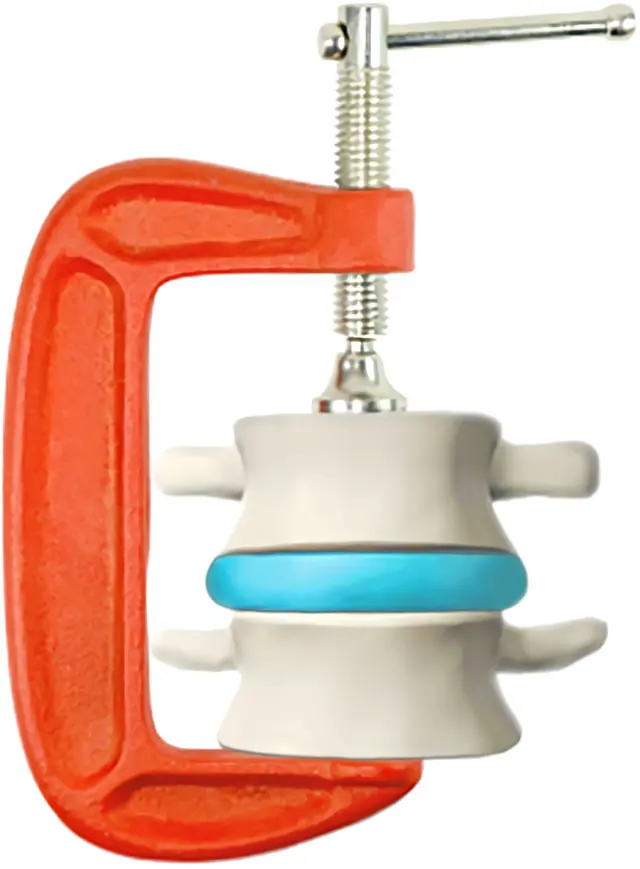
Anatomy of an unavoidable herniated disc: if your pelvis is tilted or if you suffer from scoliosis, the vertebrae do not distribute their weight over the entire surface of the disc, but only over part of it. The situation is further aggravated if you have other spinal abnormalities.
The consequences are easy to imagine: over time, the spot on the intervertebral disc where most of the weight is continuously placed deteriorates, creating the conditions for an impending disc protrusion or herniation.
Persistent excessive muscle tension due to poor posture grips the vertebrae like a vice; the freedom of movement of the interposed intervertebral disc is severely limited. As the constant pressure on the disc increases, the spine becomes increasingly rigid and less flexible.
To remain effective and intact, the intervertebral discs exchange nutrients and waste products with the external tissue, thanks to the pressure changes that occur during disc compression and decompression, when the vertebrae move. Disc nutrition works according to this principle because the intervertebral discs cannot be vascularised like other tissues, for the simple reason that intradiscal pressure is much higher than blood pressure.
The load on the intervertebral discs also varies depending on the body position. Between standing and lying down, contrary to what one might imagine, the load on the discs is reduced by only 20%. In the unfavourable condition described above, the already low 20 per cent is reduced even further, compromising the important regeneration phase of the intervertebral discs that takes place during sleep in a horizontal position. Over the years, the intervertebral discs "dry out" and lose their elasticity, so that the disc may tear as soon as it is subjected to a certain load.
What to do about a discopathy?
It is possible to surgically remove the portion of the ruptured disc. The escaped pulp puts pressure on the nerve roots emerging from the spine, causing pain and paraesthesia in the limbs. Nowadays, alternative solutions are preferred because such operations are not risk-free, can lead to complications and induce chronic pain, as observed in many people.
This solution certainly does not eliminate the main cause of bad posture, so the situation can degenerate into new herniated discs later on. Why not solve the problem at its root? And by root I don't mean the nerve root compressed by the herniation.
If no other interfering factors are present, repositioning the Atlas allows the pelvis to be levelled and the posture to be corrected. The resulting improved distribution of the loads on the intervertebral discs and the reduction in muscle contractures considerably promote the spontaneous process of hernia resolution and reduce the risk of subsequent herniations.
Atlas correction is indicated above all for the prevention of herniated discs and in the case of disc protrusion.
Atlantomed aims to eliminate the cause which then degenerates into the pathology, rather than targeting the disorder itself. Therefore, in the case of herniated discs in an advanced stage, it may be necessary to intervene with further therapies.
We strongly recommend that you also inform yourself about the non-invasive SPINEMED treatment.
Remember: To repair a punctured tyre, you must first plug the hole and then reinflate the wheel. Reversing the order or performing only one of the two operations inevitably leads to failure.
Videointerviste ernia del disco
racconti dopo il riallineamento dell'Atlante
Alcune testimonianze dal forum
- Fralic: Discopatie: blocco lombare addio
- Adelante: Miglioramento per le mie ernie del disco
- Lolito: Niente più dolori da ernia del disco - sono rinato
- Patrizia: Risolta l'ernia del disco
- Altre testimonianze: protrusioni – ernia del disco – discopatia
What people say about us
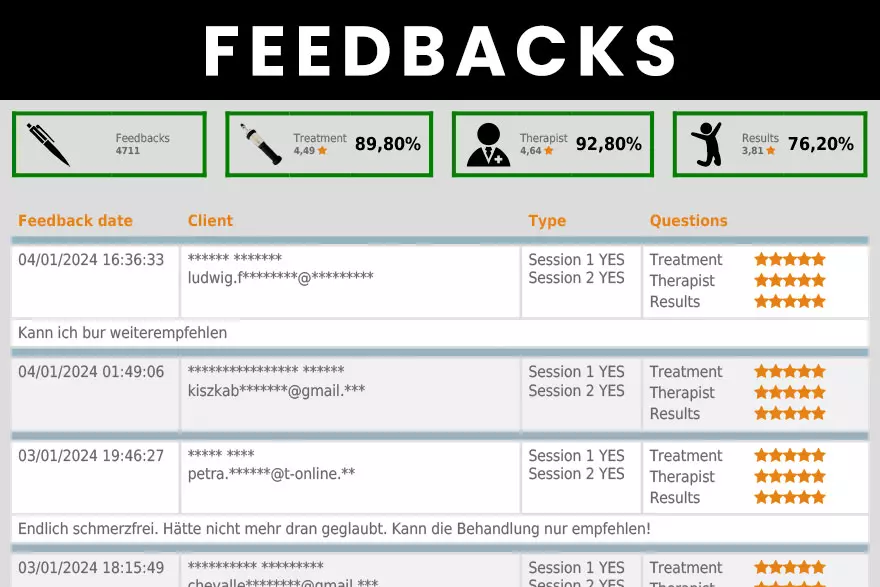
The only ones with over 9000 testimonials and reviews in several languages! Click to access the related platforms and read many opinions, feedbacks, experiences and testimonials after the Atlantomed vibro-resonance Atlas correction. Be wary of imitations.
0
video testimonials
0
Google reviews

0
Facebook reviews

0
case studies
0
feedbacks
0
forum testimonials

Written by: Alfredo Lerro
