

 Sweden
  Español
  Italiano
  Deutsch
  Français
 Who says migraine is unhealable?
In the medical and scientific literature, migraine is described as an incurable neurological disease. Conventional medicine tries to influence the neurochemical balance in migraine patients through the use of drugs. This is a completely unsuccessful attempt in the long term.
If you also suffer from migraine, it should be clear to you that the persistence of your migraine is not due to "not having found the right medication to take yet". Regardless of which tablet you take, this remedy will always remain only a temporary, non-resolving solution.
A migraine medication is fine as a temporary emergency stopgap, but in parallel you should look for a long-term solution and stop deluding yourself that you can find one with your doctor. You would do better to look elsewhere.
If you also suffer from migraine, it should be clear to you that the persistence of your migraine is not due to "not having found the right medication to take yet". Regardless of which tablet you take, this remedy will always remain only a temporary, non-resolving solution.
A migraine medication is fine as a temporary emergency stopgap, but in parallel you should look for a long-term solution and stop deluding yourself that you can find one with your doctor. You would do better to look elsewhere.
The only thing I see are millions of migraineurs who continue to swallow all kinds of pills for life, as if their liver was just a non-essential accessory and their survival did not depend on it.
I see people who are willing to do anything to stop the pain, people who are frantically searching for the best neurologist and the best drug, like a hamster who keeps running in the wheel, without realising that it is impossible to find a solution where none exists.
I say this for your own good: if you suffer from migraine, you should abandon the wheel and understand how the mechanism works. You should make an effort to look for the real causes of your migraine and what REAL solutions exist. I assure you that they DO exist, but they certainly don't consist of a prescription to take to the pharmacy.
Here is a possible definitive solution, without drugs and without side effects. A solution that runs counter to medical opinion, according to which there is no possibility of cure for migraine.
Let's start with some facts about migraine:
Migraine is a unilateral paroxysmal headache (paroxysmal: sudden violent phenomenon) that may be accompanied by other symptoms such as nausea, vomiting and hypersensitivity to light, noise and smells. About 10% of the population suffers from migraine.Conventional medicine divides migraine into two main categories: migraine with aura and migraine without aura.
Migraine without aura (common migraine): accounts for about 85% of migraine cases. It is characterised by nausea with or without vomiting. The attack may be violent and pulsating or dull and continuous, like "a weight of many kilos on the head". The pain is accentuated by movement, coughing, sneezing, exertion and exposure to light. The migraine sufferer usually prefers to lie down, in the dark and away from noise. The duration of the episodes varies from a few hours to three days, does not usually manifest itself with premonitory signs and occurs on one side of the skull, then quickly radiates to the rest of the head.
Migraine with aura (classic migraine): accounts for about 14% of migraine cases. It differs from migraine without aura in certain premonitory disturbances such as hypersensitivity to light and/or noise, obscuration of the visual field, perception of shimmering lines or flying flies. The duration of attacks varies from 4 to 24 hours.
Migraine with aura (classic migraine): accounts for about 14% of migraine cases. It differs from migraine without aura in certain premonitory disturbances such as hypersensitivity to light and/or noise, obscuration of the visual field, perception of shimmering lines or flying flies. The duration of attacks varies from 4 to 24 hours.
What does the Atlas have to do with migraine?
As already mentioned, conventional medicine is convinced that migraine is a neurological disorder. This leads them not to investigate in other directions, otherwise they would have discovered what we have been saying for over 10 years, namely that a misaligned Atlas compresses the surrounding arteries and veins, causing cerebral circulatory decompensation, which alone or in combination with other factors can trigger headaches, migraine and numerous other health problems.
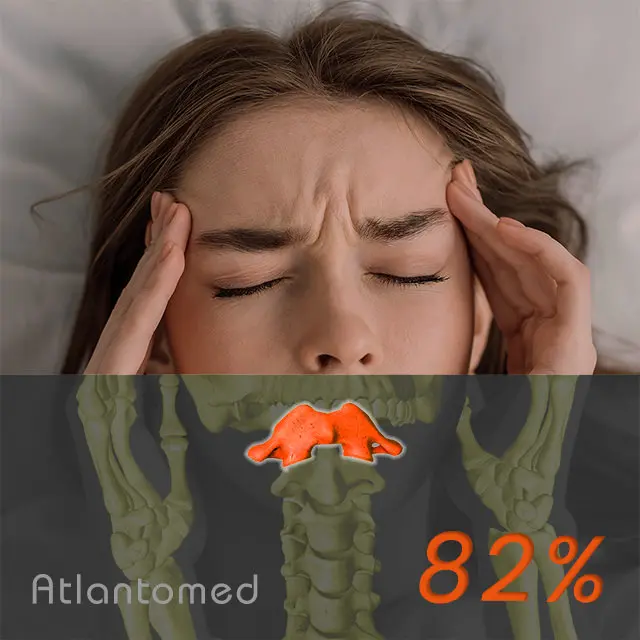
A study carried out on 504 candidates by Prof. Dr. Hans-Joachim Theis of the Inkam Institute in Germany shows that the Atlantomed method of realigning the first cervical vertebrae benefits 82% of migraine sufferers. In 39% of cases, the migraine disappears completely! Do you know of any other methods that can do this?
A study carried out on 504 candidates by Prof. Dr. Hans-Joachim Theis of the Inkam Institute in Germany shows that the Atlantomed method of realigning the first cervical vertebrae benefits 82% of migraine sufferers. In 39% of cases, the migraine disappears completely! Do you know of any other methods that can do this?
The theory that migraine is a neurological disease melts away like snow in the sun after the Atlas correction.
Migraine from a medical point of view

Patients with headache or migraine usually go to their doctor with the expectation of being HEALED. They soon discover that the doctor's concept of healing is very different from their own.
The doctor is taught that the treatment to be administered when a patient suffers from migraine should consist of symptom and pain suppression. With a good dose of short-sightedness, they ignore the fact that the symptom will almost certainly return if the underlying cause is not sought and resolved.
The doctor visits the patient, takes an anamnesis and then diagnoses one type of migraine or headache rather than another, with the aim of prescribing the 'best' medication.
There is no question of a definitive cure, as desired by the patient. Conventional medicine assumes that migraine cannot be cured and therefore deliberately insists on the same unsuccessful direction. Is it an effective solution to reduce the problem for a few hours at the cost of heavy side effects?
It should be abundantly clear to everyone that the pharmaceutical industry has no interest in finding a final cure for migraine and other disorders: a patient 'for life' is much more profitable than a patient who is finally cured!
The doctor is taught that the treatment to be administered when a patient suffers from migraine should consist of symptom and pain suppression. With a good dose of short-sightedness, they ignore the fact that the symptom will almost certainly return if the underlying cause is not sought and resolved.
The doctor visits the patient, takes an anamnesis and then diagnoses one type of migraine or headache rather than another, with the aim of prescribing the 'best' medication.
There is no question of a definitive cure, as desired by the patient. Conventional medicine assumes that migraine cannot be cured and therefore deliberately insists on the same unsuccessful direction. Is it an effective solution to reduce the problem for a few hours at the cost of heavy side effects?
It should be abundantly clear to everyone that the pharmaceutical industry has no interest in finding a final cure for migraine and other disorders: a patient 'for life' is much more profitable than a patient who is finally cured!
If you become aware of this reality, you begin to look for alternative solutions for so-called 'incurable diseases' such as migraine yourself. Atlantomed represents one of those solutions, given its high success rate, I would say THE solution.
Unfortunately, before we become aware of this and look for alternative ways, we often have to bang our heads together, after having dealt with drug-induced gastritis and an increasingly unbearable headache.
Medications can certainly be useful in emergency cases, but they should certainly not be used as a permanent solution for recurring migraine! The cause should be researched and solved once and for all, but we know that pharmaceutical companies have no interest in this and to keep you happy they tell you that migraine is not curable.
Do you ever think about your liver and the long-term side effects when you are constantly taking drugs?
Why can misalignment of the Atlas cause migraine?
The lateral apophyses of a misaligned Atlas exert pressure on the carotid artery and the internal jugular vein, and traction is also exerted on the vertebral artery as it passes through the lateral apophyses. The vertebral artery is responsible for the blood supply to the cerebellum, while the carotid artery is essential for vascularising the brain.
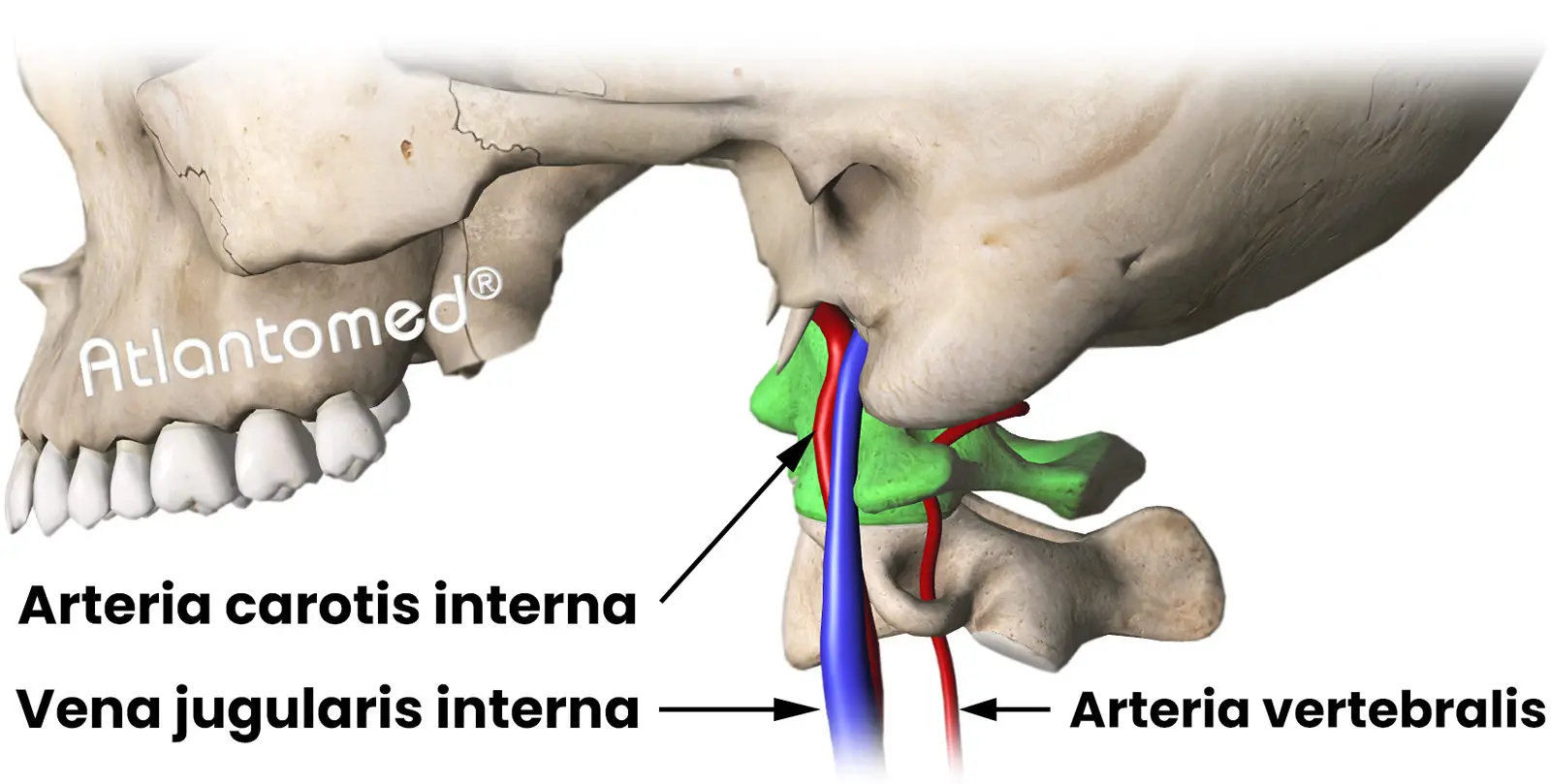 Crushing can produce both a reduction in blood flow and a reduction in blood outflow, depending on whether the compression affects the artery rather than the vein. This explains the feeling of pressure or 'pounding' in the head, as well as the pallor of the face. The latter is also the vegetative response to severe pain.
The altered blood flow reduces oxygenation of the brain and generates a transient malfunction of nerve cells, the so-called neurological deficit, which can last from a few hours to entire days. With each additional factor contributing to the impairment, the situation becomes increasingly precarious, and as soon as the critical threshold is exceeded, a migraine attack is triggered.
In some people, misalignment of the Atlas also produces an alteration in the circulation of the cerebrospinal fluid, with a consequent increase in intracranial pressure, also known as idiopathic endocranial hypertension.
Stress, overwork, anxiety and nervousness promote the onset of headaches and muscular tension in the back of the neck, which further exacerbate the pain.
It is interesting to note how the same type of misalignment of the Atlas can trigger a migraine in one person and not in another, depending on subjective differences: size of the Atlas, space available between the various anatomical elements, presence of a craniomandibular dysfunction, sensitivity to triggering factors, degree of muscular tension, condition of intoxication of the body, liver and intestine, not forgetting the extremely important variable of the emotional state.
In the following two animations you can see how a misaligned Atlas compresses the internal jugular vein, the internal carotid artery and the vagus nerve.
ARTERIA CAROTIDE
NERVO VAGO
VENA GIUGULARE
It is also noteworthy that migraine is typically unilateral. This can be explained by the nature of the misalignment of the Atlas itself: a misaligned vertebra on one side impairs the corresponding blood vessels on that side, which then corresponds to the area where the migraine is triggered.
Some triggering factors for a migraine attack
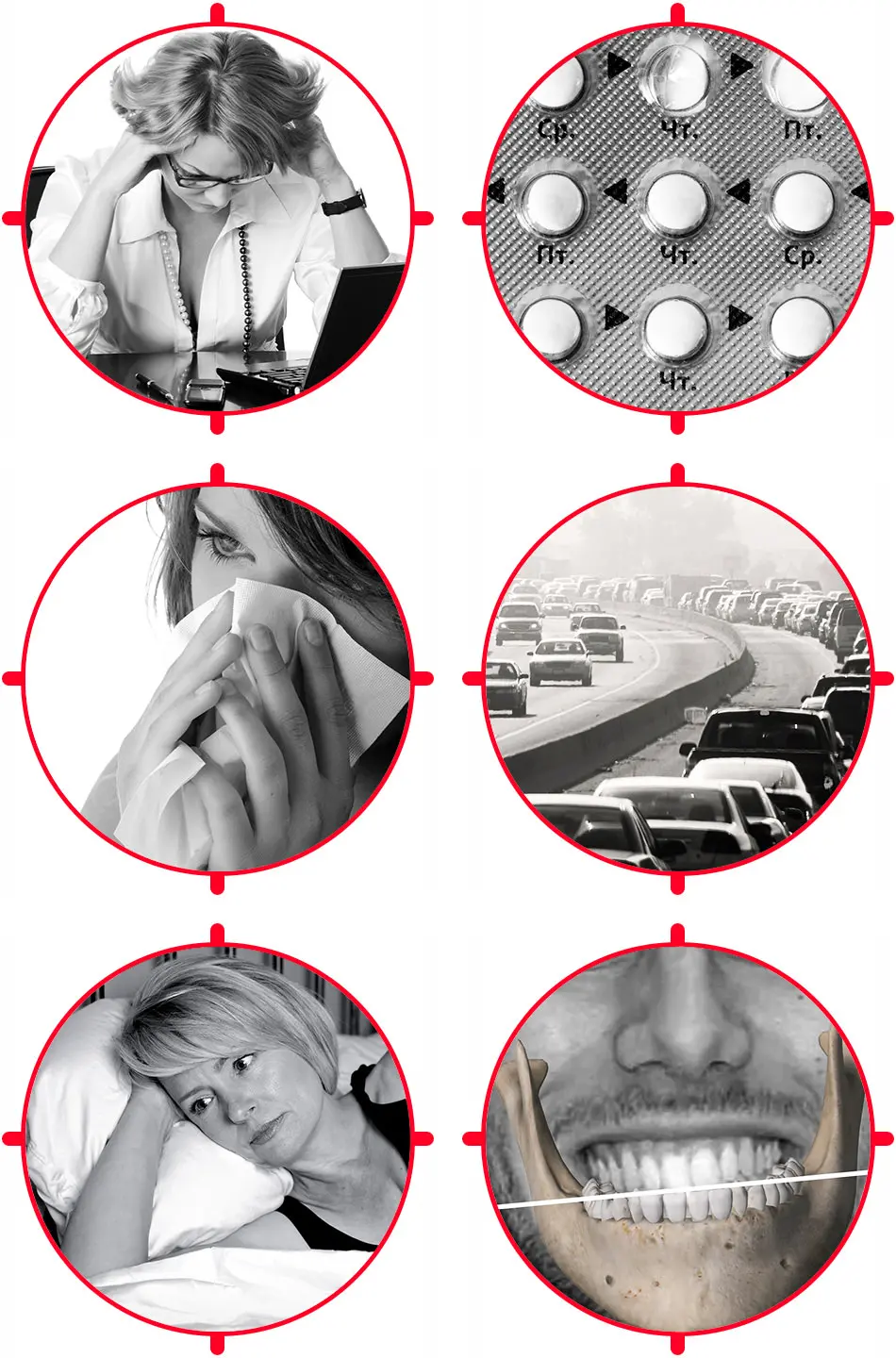
- stress
- illness
- lack of sleep
- hormonal changes
- vertebral subluxation
- misalignment of the Atlas
- Stale air or air conditioning
- abnormal dental occlusion (malocclusion)
- food allergies (food intolerances)
- alcohol, chocolate, cheese, aspartame, sodium glutamate (E621)
- rapid changes in weather conditions (atmospheric pressure, temperature, humidity)
ATTIVA L’AUDIO DEL PLAYER
The accumulation of these and other factors, which together exceed a certain threshold, triggers a migraine attack. The various triggering factors are not constant, but can change in order of importance over the course of a lifetime. An example of this is hormonal changes due to menopause or pregnancy, which in some cases reduce the frequency of migraine, put an end to attacks or trigger them.
The factors mentioned above seem to be less influential than the misalignment of the Atlas. Experience has shown that by correcting the position of the first vertebra, the other factors are very often no longer sufficient to trigger a migraine attack. What used to be the straw that broke the camel's back is now no longer able to reach the critical threshold on its own.
It is not uncommon to see women who suffer from migraines during their menstrual cycle, and who, after believing for years that their migraines are purely hormonal, have had to completely change their minds after the Atlas correction.
Since the Atlas is a purely mechanical problem, when it is resolved it can happen that the migraine or headache resolves almost immediately. At other times, however, a regeneration phase is necessary, which requires a little patience.
People who suddenly get rid of their migraine, after years of suffering and unsuccessful attempts to get rid of it, are completely stunned and disbelieving. As if they were absurdly attached to it, they feel a sense of emptiness, unable to come to terms with the fact that their unwanted 'companion' has abandoned them.
The factors mentioned above seem to be less influential than the misalignment of the Atlas. Experience has shown that by correcting the position of the first vertebra, the other factors are very often no longer sufficient to trigger a migraine attack. What used to be the straw that broke the camel's back is now no longer able to reach the critical threshold on its own.
It is not uncommon to see women who suffer from migraines during their menstrual cycle, and who, after believing for years that their migraines are purely hormonal, have had to completely change their minds after the Atlas correction.
Since the Atlas is a purely mechanical problem, when it is resolved it can happen that the migraine or headache resolves almost immediately. At other times, however, a regeneration phase is necessary, which requires a little patience.
People who suddenly get rid of their migraine, after years of suffering and unsuccessful attempts to get rid of it, are completely stunned and disbelieving. As if they were absurdly attached to it, they feel a sense of emptiness, unable to come to terms with the fact that their unwanted 'companion' has abandoned them.
Videointerviste emicrania
If you watch some video interviews or read the testimonials of people who have been treated with Atlantomed, you will realise two things:
racconti dopo il riallineamento dell'Atlante
Alcune testimonianze dal forum con emicrania
- marius.stone: Emicrania cronica
- Stefania.b: Dopo anni di cure insoddisfacenti...
- ArdengoS.: Emicrania: una guarigione senza farmaci
- Stefania: Emicrania: tutta un'altra vita
- Marta: Mal di testa ed emicrania dopo caduta
- Italo: Mal di testa addio
- Maria53: Emicrania di minore entità
- Nunù erric: Rinascere senza Emicrania: MIRACOLOSO!
- nunzia: cefalea a grappolo: sto bene 99 su 100!!!!!
- ulteriori testimonianze: emicrania con e senza aura
Adesso hai la possibilità di evadere dall'incubo della tua emicrania
What people say about us
The only ones with over 9000 testimonials and reviews in several languages! Click to access the related platforms and read many opinions, feedbacks, experiences and testimonials after the Atlantomed vibro-resonance Atlas correction. Be wary of imitations.
0
video testimonials

0
Google reviews

0
Facebook reviews

0
case studies

0
feedbacks

0
forum testimonials

Letteratura scientifica emicrania

- Effect of Atlas Vertebrae Realignment in Subjects with Migraine.
- Cervicogenic Headache: Evidence That the Neck is a Pain Generator.
- Cervicogenic headache in patients with presumed migraine.
- Cervicogenic headache.
- The lateral atlanto-axial joint as a source of headache.
- Cervicogenic headache: etiopathogenesis, characteristics, diagnosis.
- Correlation between chronic headaches and the rectus capitis posterior minor.
- Atlanto-occipital and lateral atlanto-axial joint pain patterns.
Written by: Alfredo Lerro
